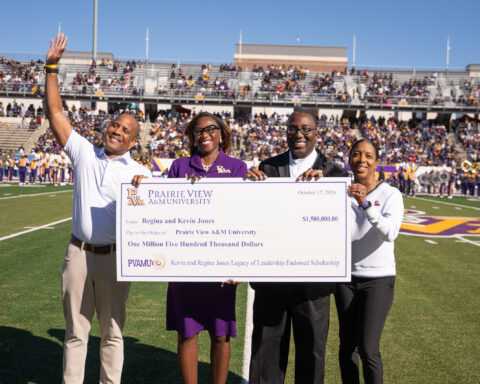

The oversized check is a homecoming ritual now. At Tuskegee last fall, the Class of 1995 posed in the chapel with a check for $44,961.29, dated the weekend of the game. Multiply that photograph by every class year, every tailgate and every gala on an HBCU campus this month, and you have the machine Dr. Michael L. Lomax described in an essay UNCF published on October 19.
Lomax, UNCF’s president and chief executive, calls homecoming “the single most important fundraising catalyst for the year” for most HBCUs. His ask this fall is direct: alumni should double their giving, challenge their classmates to match them, and treat the weekend as the start of a year of giving rather than the whole of it. The essay first ran in The HBCU Times.
What homecoming money looks like
The giving starts before anyone reaches a stadium seat. Alumni issue class challenges to one another. Donors time major gifts to the weekend. Tailgating passes and vendor spots run from $400 to more than $750 a space, and the money flows straight to the school. Clark Atlanta University secured more than $1.5 million in donor gifts at its first post-pandemic in-person homecoming. Last year, the University of Arkansas at Pine Bluff received a record $5 million gift from the Wingate Foundation during its homecoming week.
The schools receiving that money carry weight far beyond their campuses. HBCUs generate $16.5 billion in total economic impact a year, according to figures Lomax cited, and a recent UNCF report, “Still Punching Above Their Weight,” found that in 2022 HBCUs produced 16 percent of the STEM degrees awarded to Black graduates, including 20 percent of those awarded to Black women.
The number that explains the strain
One statistic in the essay does more work than the rest. Research by the TIAA Institute found that 95 percent of HBCU endowment funds are designated for student aid, compared with 40 percent nationally. The generosity is real, and so is the trap: money restricted to scholarships cannot repair a dormitory, rebuild a laboratory or hire faculty.
The backlog shows it. A UNCF report found nearly two-thirds of surveyed HBCUs carrying more than $5 million in deferred maintenance. For public HBCUs, the Government Accountability Office average is more than $60 million per school. Alumni participation sits at 5 percent, the same as the national average for higher education, though a few schools prove a higher ceiling is possible: alumni at Bennett College, Claflin University, Spelman College and Tuskegee University give at rates above 25 percent.
Atlanta has watched this work up close for decades. Billye Aaron, whom the city honored this month, spent 14 years as UNCF Atlanta’s development director and helped build the Mayor’s Masked Ball into a fundraising institution during that tenure, work The Social Register covered this week. The ball and the homecoming weekend run on the same principle: gather the people who love the place, in a room or on a quad, and ask them properly.
Lomax is clear that alumni checks alone will not close the gap. He names the federal government, corporations and large philanthropists as parties who owe HBCUs more, and he points to UNCF’s own push to build endowments that produce income for generations. His full essay is at UNCF.
“Investing in them is investing in excellence, opportunity and the American dream,” Lomax wrote. “The question, as always, is whether we will match our institutions’ effort with our own.”
The Social Register’s event directory tracks the season’s galas, benefits, and society evenings. Plan your next evening there.