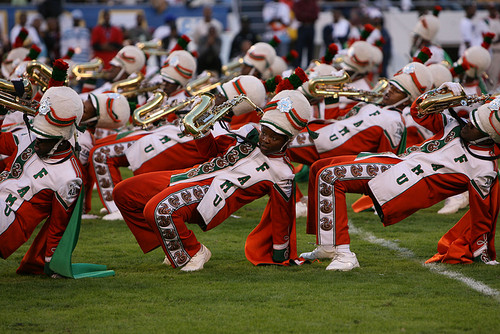
The Marching “100” has played halftime shows that outdrew the football games around them. Now the band has a $2 million gift behind it, and a challenge attached that could double the effect.
Bernard and Shirley Pooler Kinsey gave Florida A&M University $2 million for scholarships and operational support for the Marching “100,” the university announced in a roundup of recent HBCU gifts compiled by The Journal of Blacks in Higher Education. Of the total, $1.5 million goes into an endowed fund for marching band student scholarships and operational needs. The remaining $500,000 is directed to immediate program priorities, money the band can spend now rather than wait on endowment returns.
A match with a clock on it
The gift also establishes the Kinsey Marching “100” Matching Challenge, a 36-month fundraising drive built to inspire an additional $2 million in philanthropic support. The structure matters. An endowed gift pays out slowly and lasts; a matching challenge pulls new donors in on a deadline and converts one couple’s generosity into a campaign. If the challenge meets its goal, the Kinseys’ $2 million becomes $4 million in band support within three years.
Marching bands at HBCUs are recruitment engines, alumni magnets, and the most visible ambassadors most of these universities have. Funding one at this level is a statement about what a university’s public face is worth.
The same week in HBCU grants
The Kinsey gift led a week of federal and foundation awards across HBCUs:
- Elizabeth City State University received a $1.2 million federal TRIO Educational Opportunity Centers grant from the U.S. Department of Education. The money establishes centers serving 850 adults a year across seven northeastern North Carolina counties: Beaufort, Chowan, Hyde, Pasquotank, Perquimans, Tyrrell, and Washington. Adults who want to begin or resume their education get free college-access and career-planning services.
- Coppin State University in Baltimore received $1,185,000 from the U.S. Department of Education to prepare 20 special education teachers: 10 students in the bachelor’s program in special education and 10 in the master’s in teaching. The grant covers tuition and fees, books, supplies, technology, and licensure exams, and Coppin faculty will partner with Anne Arundel County Public Schools for school-based experience.
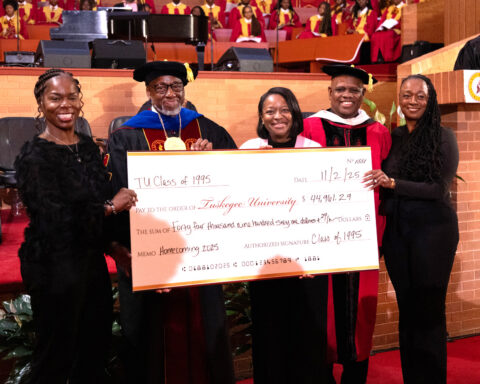
- Tuskegee University‘s College of Arts and Sciences received $595,217 from the Sherman Fairchild Foundation to modernize its biology and chemistry teaching laboratories, with new instrumentation and course-based undergraduate research built into introductory labs.
- A Winston-Salem State University faculty team received $496,376 from the National Science Foundation for work on cybersecurity attacks involving artificial intelligence, and a joint team from Southern University and Grambling State University received $893,779 from the NSF to study 6-PPDQ, a contaminant from tire wear, over three years.
The pattern across the week is worth noticing: a private couple endowing the band in Tallahassee, federal money widening the college door in rural North Carolina, and a foundation paying for the lab benches at Tuskegee. Different doors, same house.
The Marching “100” matching challenge runs for 36 months. The band, as usual, will not be hard to hear coming.
The Social Register’s event directory tracks the season’s galas, benefits, and society evenings. Plan your next evening there.